Wonderful reader Eva writes to ask ..
haven't found anything to help me understand how Grey & Adrian were captured and put in that French prison with Annique. I feel like it was something with Adrian's injury but I'm not sure why I believe that. I think I just get so lost in the story I forget to look for those missing pieces of information. Is it written somewhere?
Ah. Here we have wandered out of Annique's story and into the edges of Adrian's story.
In the weeks before Spymaster's Lady opens, Adrian is on assignment as the key element of a large operation. It's an important op indeed, since Grey is in France, in person, directing, and ready to pull Adrian out if it all goes south.
Spying his merry way through the operation, Adrian has the misfortune to run into an old adversary. Old adversary, old friend, old lover, old rival ... anyhow, she knows him very well.
It's just bad luck she's there. Sometimes, on an operation, you run into bad luck.
Covers are blown. Carefully laid plans go awry. Plots unravel. Adrian gets shot when he's naked in bed with his old lover.
She shoots him. Talk about your wake-up calls.
Our lad is out the window, grabbing his clothes on the way.
Adrian's done this much . . . the op can be salvaged. Grey and Doyle step in to do that. But Adrian's on the streets, running.
When Grey goes to scoop him up, they're both captured.
This all happens outside the bounds of Spymaster's Lady, though. We catch only the merest whiff of it there.
ETA in July 2010: When I actually sat down to write the JUSTINE story, I decided to do things somewhat differently. So this is not what happened.
Just forget about all this part . . . okay?
Wednesday, June 24, 2009


Wednesday, June 03, 2009
Plotting . . . plotting . . . plotting . . .
Sometimes, it's just one plot problem after another. You fix one, and another pops up.
Kinda like . . . this.
Kinda like . . . this.
Monday, June 01, 2009
Spanish Spymaster
 Spanish . . . Spanish . . . I am in Spanish.
¿Usted habla español? ¿Usted sabe alguien que habla español?
This is your chance.
Cool cover, isn't it?
I really like 'Annique in red silk'.
Babelfish says this title means 'Disarmed by a Dance'.
Ok.
They call Grey ... El jefe de los espías británicos. Isn't that wonderful? I will now think of Grey as El Jefe.
So far, this one wins the limited but fierce competition for 'Least Clothing Per Person on a Joanna Bourne Cover'.
I think Desarmado Por Un Bale goes for sale on June 15th.
I hope to someday hold this in my hands so I can figure out what all that stuff down along the bottom and in the lower right hand corner is. That circle stuff. Some city ...?
Now this cover is not just quite exactly how I think of Grey. It looks a bit like Leonardo DiCaprio in Titanic.
But it is just beautifully composed, isn't it?
ETA -- In the comment trail it is pointed out that the cover figure appears on another book. There, it can be discerned that the mysterious circle is part of the dancing costume. Mystery solved. I am so pleased.
Wednesday, May 20, 2009
Spymaster's Lady in Russian

I seem to be out in Russian.
I do want to find out how to get a copy of it.
Has to be some way ...
Interestingly enough, the cover seems related to the scene, and they've got Grey's shirt historically correct.
!
The title in Russian apparently translates to 'Secret Courtesan'.
The God of Romance Titles has not finished toying with me.
This cover is truly in competition for 'Cover of a Joanna Bourne Book Most Related to the Actual Story'.
ETA -- The better translation of the title is 'The Courtesan's Secret'. Very nice. Thanks so much to Russian reader Ksu for help on this.
Technical Topics -- Beginnings
Let's say you have finished a good rough draft of the manuscript,
(Yipee!)
and you come back to look at the beginning,
and you don't know whether it's any good.
How do you judge a beginning?
You can do something like this here below.
This is just a starting point for thinking about your plot, but it has the merit of being both specific and brief.
1) Pick up the first three pages only.
-- Do these first three pages put you in an interesting place?
-- Does something happen?
-- Does that action give rise to what is going to happen in at least one scene after page fifty?
-- Do we connect with at least one character and her problems?
-- Do we understand who she is and what she wants?
2) Set the first three chapters to one side,
(over there on the edge of your desk,)
and look at the beginning of Chapter Four.
-- What action takes place before this point that is wholly necessary to tell your story?
-- Could you just as easily start the story here?
No, really.
Could you start the story right here and it would all be understandable and the plot would work just fine?
3) Slip a paperclip onto page 10, page 23, page 37 and page 48.
Read the story quickly, from the beginning.
When you get to the bottom of a paperclipped page, set it down and ask yourself:
--What intriguing question fills your mind right now?
-- Is that question so enticing that you must pick that manuscript up and read on?
4) Take out two colors of highlighter.
Yellow and fuschia maybe.
You're going to go through the first four chapters.
Use yellow to mark a line along
-- dialog, (with the exception of someone explaining and telling stuff,)
-- dialog tags,
-- a character thinking about something or someone they can see right in front of them,
-- an action that is happening onstage right now,
-- the POV character smelling, touching, tasting or hearing something,
-- the description of something the POV character can see.
Use fuschia to mark a long line along
-- anything that happened in the past,
-- a character thinking about something that is not immediately in front of her,
-- the description of something the POV character cannot see,
-- anything related to a character who is not present,
-- one person explaining anything at all to the other person,
-- one person telling the other person what happened somewhere else.
Do you have lots and lots of yellow?
Maybe 80% yellow?
That is the here-and-now of your story.
If the reader is not in the midst of the here-and-now of your story . . .
where is she?
5) Finally, just read the first five chapters.
Do you care about these people?
Do you see them headed somewhere?
It is an interesting exercise to go through this with authors you enjoy.
Pick up one of Nora Roberts' books that you've somehow managed to acquire in duplicate. Limber up your yellow marker.
It is instructive to see a master at work.
(Yipee!)
and you come back to look at the beginning,
and you don't know whether it's any good.
How do you judge a beginning?
You can do something like this here below.
This is just a starting point for thinking about your plot, but it has the merit of being both specific and brief.
1) Pick up the first three pages only.
-- Do these first three pages put you in an interesting place?
-- Does something happen?
-- Does that action give rise to what is going to happen in at least one scene after page fifty?
-- Do we connect with at least one character and her problems?
-- Do we understand who she is and what she wants?
2) Set the first three chapters to one side,
(over there on the edge of your desk,)
and look at the beginning of Chapter Four.
-- What action takes place before this point that is wholly necessary to tell your story?
-- Could you just as easily start the story here?
No, really.
Could you start the story right here and it would all be understandable and the plot would work just fine?
3) Slip a paperclip onto page 10, page 23, page 37 and page 48.
Read the story quickly, from the beginning.
When you get to the bottom of a paperclipped page, set it down and ask yourself:
--What intriguing question fills your mind right now?
-- Is that question so enticing that you must pick that manuscript up and read on?
4) Take out two colors of highlighter.
Yellow and fuschia maybe.
You're going to go through the first four chapters.
Use yellow to mark a line along
-- dialog, (with the exception of someone explaining and telling stuff,)
-- dialog tags,
-- a character thinking about something or someone they can see right in front of them,
-- an action that is happening onstage right now,
-- the POV character smelling, touching, tasting or hearing something,
-- the description of something the POV character can see.
Use fuschia to mark a long line along
-- anything that happened in the past,
-- a character thinking about something that is not immediately in front of her,
-- the description of something the POV character cannot see,
-- anything related to a character who is not present,
-- one person explaining anything at all to the other person,
-- one person telling the other person what happened somewhere else.
Do you have lots and lots of yellow?
Maybe 80% yellow?
That is the here-and-now of your story.
If the reader is not in the midst of the here-and-now of your story . . .
where is she?
5) Finally, just read the first five chapters.
Do you care about these people?
Do you see them headed somewhere?
It is an interesting exercise to go through this with authors you enjoy.
Pick up one of Nora Roberts' books that you've somehow managed to acquire in duplicate. Limber up your yellow marker.
It is instructive to see a master at work.
Tuesday, May 12, 2009
Technical Topics -- Words, Words, Words in MLAS
Here are some fine and careful points of word usage from My Lord and Spymaster, brought to you by the excellent Franzeca Drouin.
Franzeca, who knows everything about words, pretty much, and helps authors out when they're using them kinda careless like, lives at her website here.
And a very interesting website it is.
Drop by and look through her 'sources' if you're doing research anywhere in the period.
Leesee
We open on Page 2 with the perplexing matter of finicky.
The passage is: Pretty soon there'd be nobody in the street but her and that cat picking his way, finicky, across the cobbles. He had errands to run, that cat. You could tell by looking at him.
Franzeca points out that OED dates 'finicky' to 1825, with a note that it's mostly US. Googlebooks lets us find 'finicky' in print as early as 1819.
This is, unfortunately, seven years after the date of MLAS.
What folks would have said in C18 was 'finicking'. Fielding, for instance, says, "I have none of the cant of your fine finicking London chaps."
C19 saw the introduction of 'finicky' as an alternative. This robust variant eventually replaced 'fincking',
for which I am sure we are all grateful.
By the last half of C19, 'finicky' and 'finicking' are about equally common.
I looked at the two possibilities and dithered a second or two and chose finicky.
I'm accepting this word into my period vocabulary under my 'One Decade Rule'
What I figure is, slang and idiomatic usage didn't go just galloping into print in early C19. Respectable people disapproved of informal usage.
I'm allowing the lapse of a decade between idiom on the streets and appearance in print. Longer than that if the idiom is vulgar.
Americanisms aren't at all unlikely for my heroine. Jess dealt with Yankee merchants all the time.
As a sidebar --- Why 'finicky'?
'Finicking' sounds ye-olde-C18 to my modern ears. Sounds niffy-naffy. It's not the way my Jess would talk. I want the blunter 'finicky' to build her voice.
When I picked 'finicky' I knew I was dealing with a fairly new C19 word, but I admit I hadn't realized 1812 was cutting it quite so close.
Moving on to Page 6 of MLAS, we get 'caper'.
The passage is: Back when she engaging in criminal acts with some regularity she'd have called this a right pig of a caper.
'Caper', meaning a dodge or scam, dates in writing to 1839.
I comment on this here.
You saw the 'One Decade Rule' above?
I'd argue that thieves cant entered the written record long after the date it was actually used. In early C19 we have only a couple few 'dictionaries' that preserved a mere scant few hundred words of what must have been a wide and rich vocabulary. Almost certainly, any bit of the argot that made it into these dictionaries was old, old, old in the slums.
This is my 'Trash Talk Rule'.
I'm going to stake out the ground for yet another quibbling excuse. The 'Perfect Word' excuse.
Some technical jargon is just so simple and exact and irreplaceable and there is NO period equivalent so I take an aspirin and grit my teeth and use it.
Coming to page 6. Standby.
The passage is: She'd tried bribes, threats, blackmail--all the old standbys.
As Franzeca says, 'standby' depends on exact usage of standby; someone available to render assistance, 1801; a support or resource, 1861.
Ok. I was wrong. Wrong. Wrong!
Because I am using it in the 'support or resource' sense.
I suppose . . . this might be an independent early metaphoric usage.
Can I say that? Huh? Huh? Independent invention of the metaphor?
Now we come to a real zinger.
Ouch.
Page 20. 'black out'
The passage is: "Don't be stupid. Hurts everywhere." She decided to black out for a while. Her eyes slid shut and she went limp.
Franzeca dates 'black out' in the sense of 'to temporarily lose consciousness,' to 1940.
Arrrggghhh.
I should have known this. And it doesn't even sound period. It sounds C20.
I was just wrong.
Wrong, wrong, wrong, wrong, wrong.
Mea culpa.
Page 40. 'unconscious'
The passage is: Damn. Was he really thinking that way about an unconscious woman?
Franzeca points out that 'unconscious' is old as meaning unaware. As a medical term indicating loss of consciousness, it dates only to 1860.
I didn't know.
Having bloopered this way, I would do this again. In fact, I probably will. My characters will continue to fall 'unconscious' right and left in future manuscripts, rather than faint or swoon or something.
I'm pulling out the 'Perfect Word' rule on this one.
This is another of those technical jargon words that are exact and clear and simple and don't have a robust period equivalent.
A really careful writer wouldn't use 'unconscious'. I'm going to be less careful and accurate. I assume the karmic burden of this.
Franzeca says ... "Page 42: and elsewhere 'Cockney' you capitalize, which seems correct to me, as a noun and adjective of ethnic origin. Mostly not capitalized in OED, and it doesn’t look right. Harrumph."
Well, I feel good about capitalizing.
Presumably a word that starts out as a proper name eventually gets tired of maintaining a capital letter and just sinks into small letters in exhaustion.
We will not encourage this slackness. One must have some standards.
Page 58: Borneo in OED, 1876; first treaty involving the island of Borneo and Britain, 1824. Because of political and administrative districts on Borneo, might not be referred to as island title, but political titles. Jess’s knowledge of shipping would make her more aware of this arcane information."
I love obscure and arcane. Certainly Jess would know the name of every island in the Pacific that exported anything and all its political nitpickery.
I figger, here, she just meant the island itself and that's what it was called.
For 'Borneo' as an exotic tropical island destination, see the map of 1683 here.
And Page 77, Do you mean 'strolled' or 'trolled'?
The passage is: If the Captain was Cinq, he probably strolled through Quentin's papers with great regularity. A man as careless as Quentin was just an incitement to treason.
My Jess is being metaphoric. Well, she'd be metaphoric in both cases, but in this case she's being metaphoric with 'strolled'.
And finally, we come to page 96.
'charcoal' as a color, "charcoal grey", 1952.
The passsage is: What does one wear to ransack a warehouse? Black, I think, and the charcoal waistcoat. Tasteful, yet understated."
Phooey. I'm going to decree that Adrian's not using 'charcoal' as a color in the sense of 'green', 'blue' or 'red'. He's being metaphoric, the way he might talk about the 'snuff' driving coat or the 'coffee-and-cream' jacket or the 'claret' waistcoat.
He's making a direct trip from the colored object to the metaphoric destination without a single brief stop in the artists' pallet.
Franzeca, who knows everything about words, pretty much, and helps authors out when they're using them kinda careless like, lives at her website here.
And a very interesting website it is.
Drop by and look through her 'sources' if you're doing research anywhere in the period.
Leesee
We open on Page 2 with the perplexing matter of finicky.
The passage is: Pretty soon there'd be nobody in the street but her and that cat picking his way, finicky, across the cobbles. He had errands to run, that cat. You could tell by looking at him.
Franzeca points out that OED dates 'finicky' to 1825, with a note that it's mostly US. Googlebooks lets us find 'finicky' in print as early as 1819.
This is, unfortunately, seven years after the date of MLAS.
What folks would have said in C18 was 'finicking'. Fielding, for instance, says, "I have none of the cant of your fine finicking London chaps."
C19 saw the introduction of 'finicky' as an alternative. This robust variant eventually replaced 'fincking',
for which I am sure we are all grateful.
By the last half of C19, 'finicky' and 'finicking' are about equally common.
I looked at the two possibilities and dithered a second or two and chose finicky.
I'm accepting this word into my period vocabulary under my 'One Decade Rule'
What I figure is, slang and idiomatic usage didn't go just galloping into print in early C19. Respectable people disapproved of informal usage.
I'm allowing the lapse of a decade between idiom on the streets and appearance in print. Longer than that if the idiom is vulgar.
Americanisms aren't at all unlikely for my heroine. Jess dealt with Yankee merchants all the time.
As a sidebar --- Why 'finicky'?
'Finicking' sounds ye-olde-C18 to my modern ears. Sounds niffy-naffy. It's not the way my Jess would talk. I want the blunter 'finicky' to build her voice.
When I picked 'finicky' I knew I was dealing with a fairly new C19 word, but I admit I hadn't realized 1812 was cutting it quite so close.
Moving on to Page 6 of MLAS, we get 'caper'.
The passage is: Back when she engaging in criminal acts with some regularity she'd have called this a right pig of a caper.
'Caper', meaning a dodge or scam, dates in writing to 1839.
I comment on this here.
You saw the 'One Decade Rule' above?
I'd argue that thieves cant entered the written record long after the date it was actually used. In early C19 we have only a couple few 'dictionaries' that preserved a mere scant few hundred words of what must have been a wide and rich vocabulary. Almost certainly, any bit of the argot that made it into these dictionaries was old, old, old in the slums.
This is my 'Trash Talk Rule'.
I'm going to stake out the ground for yet another quibbling excuse. The 'Perfect Word' excuse.
Some technical jargon is just so simple and exact and irreplaceable and there is NO period equivalent so I take an aspirin and grit my teeth and use it.
Coming to page 6. Standby.
The passage is: She'd tried bribes, threats, blackmail--all the old standbys.
As Franzeca says, 'standby' depends on exact usage of standby; someone available to render assistance, 1801; a support or resource, 1861.
Ok. I was wrong. Wrong. Wrong!
Because I am using it in the 'support or resource' sense.
I suppose . . . this might be an independent early metaphoric usage.
Can I say that? Huh? Huh? Independent invention of the metaphor?
Now we come to a real zinger.
Ouch.
Page 20. 'black out'
The passage is: "Don't be stupid. Hurts everywhere." She decided to black out for a while. Her eyes slid shut and she went limp.
Franzeca dates 'black out' in the sense of 'to temporarily lose consciousness,' to 1940.
Arrrggghhh.
I should have known this. And it doesn't even sound period. It sounds C20.
I was just wrong.
Wrong, wrong, wrong, wrong, wrong.
Mea culpa.
Page 40. 'unconscious'
The passage is: Damn. Was he really thinking that way about an unconscious woman?
Franzeca points out that 'unconscious' is old as meaning unaware. As a medical term indicating loss of consciousness, it dates only to 1860.
I didn't know.
Having bloopered this way, I would do this again. In fact, I probably will. My characters will continue to fall 'unconscious' right and left in future manuscripts, rather than faint or swoon or something.
I'm pulling out the 'Perfect Word' rule on this one.
This is another of those technical jargon words that are exact and clear and simple and don't have a robust period equivalent.
A really careful writer wouldn't use 'unconscious'. I'm going to be less careful and accurate. I assume the karmic burden of this.
Franzeca says ... "Page 42: and elsewhere 'Cockney' you capitalize, which seems correct to me, as a noun and adjective of ethnic origin. Mostly not capitalized in OED, and it doesn’t look right. Harrumph."
Well, I feel good about capitalizing.
Presumably a word that starts out as a proper name eventually gets tired of maintaining a capital letter and just sinks into small letters in exhaustion.
We will not encourage this slackness. One must have some standards.
Page 58: Borneo in OED, 1876; first treaty involving the island of Borneo and Britain, 1824. Because of political and administrative districts on Borneo, might not be referred to as island title, but political titles. Jess’s knowledge of shipping would make her more aware of this arcane information."
I love obscure and arcane. Certainly Jess would know the name of every island in the Pacific that exported anything and all its political nitpickery.
I figger, here, she just meant the island itself and that's what it was called.
For 'Borneo' as an exotic tropical island destination, see the map of 1683 here.
And Page 77, Do you mean 'strolled' or 'trolled'?
The passage is: If the Captain was Cinq, he probably strolled through Quentin's papers with great regularity. A man as careless as Quentin was just an incitement to treason.
My Jess is being metaphoric. Well, she'd be metaphoric in both cases, but in this case she's being metaphoric with 'strolled'.
And finally, we come to page 96.
'charcoal' as a color, "charcoal grey", 1952.
The passsage is: What does one wear to ransack a warehouse? Black, I think, and the charcoal waistcoat. Tasteful, yet understated."
Phooey. I'm going to decree that Adrian's not using 'charcoal' as a color in the sense of 'green', 'blue' or 'red'. He's being metaphoric, the way he might talk about the 'snuff' driving coat or the 'coffee-and-cream' jacket or the 'claret' waistcoat.
He's making a direct trip from the colored object to the metaphoric destination without a single brief stop in the artists' pallet.
Sunday, May 10, 2009

Good Books of 2008
I posted this interview on the Book Smugglers website last December.
Thought I'd repost here, just to improve the world a bit by saying 'this is good,' and 'I liked this,' one more time.
My Favorite 2008 Reads
Let me start out with three great RITA winners and a Finalist. They blew my socks off.
Madeleine Hunter, Lessons of Desire.
I always love her work. Dense. Enticing. Sensual. A rare pleasure.
Deanna Raybourn, Silent in the Grave.
A new-to-me writer. Historical mystery. I love the complex, intelligent interaction between H&H. I have her next book, Silent in the Sanctuary, on my TBR shelf.
Julia Quinn, The Secret Diaries of Miss Miranda Cheever.
I spend my whole time chuckling when I read Quinn. You just fall into the delight.
Anna Campbell, Claiming the Courtesan.
(I loved Untouched, too.) High-stakes H&H interaction. Intense writing. Compelling.
Leesee … who else?
Strangers in Death, by JD Robb.
With the In-Death series … it’s like you got a box of milk-chocolate-covered nuts. You know they’re all going to be good. (Even the Brazil nut, which is one of those odd, semi-edible things where you ask yourself, ‘What was God thinking?’)
Anyhow, if we’re doing this chocolates simile . . . Strangers is when you pick the piece of candy out and it’s almonds and almonds are your favorites.
His Captive Lady by Anne Gracie.
I just finished this one last week. Lovely writing. Gotta love that Gracie.
Private Arrangements by Sherry Thomas.
She took a whole bunch of writerly risks. It all works. Character driven by unusual characters.
Simply Magic by Mary Balogh.
Intelligent Romance, as always. I find her characters appealing on so many levels. I always think I’d like to know them.
Your Scandalous Ways by Loretta Chase.
Spies. Venice. Intrigue. Hero and Heroine conflict. Loretta Chase. What more could one possibly ask?
His Dark and Dangerous Ways by Edith Layton.
One of my long-time favorite authors. I was looking forward to this one. Multi-layer and realistic characters.
It must have been the year for using 'Ways' in titles.
EDITED TO ADD: We lost Edith Layton this year. A great lady, a great writer. Vade, and we are poorer for it.
Oh, let me mention a really nifty anthology –
It Happened One Night. This is Stephanie Laurens, Mary Balogh, Jacquie D’alessandro, and Candice Hern.
They rounded up a whole bunch of my favorite authors and put ‘em all in one book.I mean … What are the odds?
I’ve left off scads of great 2008 books because they are sitting three deep and densely packed in the TBR shelf. I haven’t had time to READ them.
My TBR shelf is like …
You know how your refrigerator whispers about the piece of pumpkin pie you got on the bottom shelf (… pie …pie … pie …pie …) every time you walk by and you gotta go tiptoeing off real fast with your hands over your ears … (Lah la la la lah)
My TBR shelf is like that.
Thought I'd repost here, just to improve the world a bit by saying 'this is good,' and 'I liked this,' one more time.
My Favorite 2008 Reads
Let me start out with three great RITA winners and a Finalist. They blew my socks off.
Madeleine Hunter, Lessons of Desire.
I always love her work. Dense. Enticing. Sensual. A rare pleasure.
Deanna Raybourn, Silent in the Grave.
A new-to-me writer. Historical mystery. I love the complex, intelligent interaction between H&H. I have her next book, Silent in the Sanctuary, on my TBR shelf.
Julia Quinn, The Secret Diaries of Miss Miranda Cheever.
I spend my whole time chuckling when I read Quinn. You just fall into the delight.
Anna Campbell, Claiming the Courtesan.
(I loved Untouched, too.) High-stakes H&H interaction. Intense writing. Compelling.
Leesee … who else?
Strangers in Death, by JD Robb.
With the In-Death series … it’s like you got a box of milk-chocolate-covered nuts. You know they’re all going to be good. (Even the Brazil nut, which is one of those odd, semi-edible things where you ask yourself, ‘What was God thinking?’)
Anyhow, if we’re doing this chocolates simile . . . Strangers is when you pick the piece of candy out and it’s almonds and almonds are your favorites.
His Captive Lady by Anne Gracie.
I just finished this one last week. Lovely writing. Gotta love that Gracie.
Private Arrangements by Sherry Thomas.
She took a whole bunch of writerly risks. It all works. Character driven by unusual characters.
Simply Magic by Mary Balogh.
Intelligent Romance, as always. I find her characters appealing on so many levels. I always think I’d like to know them.
Your Scandalous Ways by Loretta Chase.
Spies. Venice. Intrigue. Hero and Heroine conflict. Loretta Chase. What more could one possibly ask?
His Dark and Dangerous Ways by Edith Layton.
One of my long-time favorite authors. I was looking forward to this one. Multi-layer and realistic characters.
It must have been the year for using 'Ways' in titles.
EDITED TO ADD: We lost Edith Layton this year. A great lady, a great writer. Vade, and we are poorer for it.
Oh, let me mention a really nifty anthology –
It Happened One Night. This is Stephanie Laurens, Mary Balogh, Jacquie D’alessandro, and Candice Hern.
They rounded up a whole bunch of my favorite authors and put ‘em all in one book.I mean … What are the odds?
I’ve left off scads of great 2008 books because they are sitting three deep and densely packed in the TBR shelf. I haven’t had time to READ them.
My TBR shelf is like …
You know how your refrigerator whispers about the piece of pumpkin pie you got on the bottom shelf (… pie …pie … pie …pie …) every time you walk by and you gotta go tiptoeing off real fast with your hands over your ears … (Lah la la la lah)
My TBR shelf is like that.
Friday, May 01, 2009

I got no work done today.
I sat in Starbucks and drank two huge lattes and looked at the scene where my villain beats up the hero,
(my villain is named Guichet right now, but that's not going to last because 'guichet' means like, that booth in the Metro where you buy tickets. I have no idea why I'm calling him that.)
and I couldn't work on it.
I sat there and did nothing.
Nothing, nothing, nothing, nothing.
So I came home and planted German iris and yellow tulips and azaleas that are this absolutely beautiful soft pink and dahlias and phlox.
Then I came inside and painted my toenails.
Pink.
Saturday, April 25, 2009
Novak Auction for Diabetes
Let me give everybody a heads up.
The Brenda Novak's On-line Auction for Diabetes Research will open May 1st and run through the month. here.
ETA: I went in and removed the photos of the jewelry. I have no problem posting the photos during the auction, but afterwards I take them out so I'm not violating anybody's copyright
ETA: I removed the photo here so I'm not violating copyright.
The Brenda Novak's On-line Auction for Diabetes Research will open May 1st and run through the month. here.
This is a worthy cause. There's great stuff to buy too.
here
We got ourselves a traditional, cameo circa 1890, and a coral cross pendant, circa 1880.
We got ourselves a traditional, cameo circa 1890, and a coral cross pendant, circa 1880.
ETA: I went in and removed the photos of the jewelry. I have no problem posting the photos during the auction, but afterwards I take them out so I'm not violating anybody's copyright
.
Or, how about
Or, how about
Be a Werewolf.
New York Times best-selling author, Cheyenne McCray will use the reader's name in NO WEREWOLVES ALLOWED. The auction winner gets to be a werewolf! The winning reader also receives an autographed copy of the book when it is released. Here.
And we got this lovely mermaid necklace.
It's here.
ETA: I removed the photo here so I'm not violating copyright.
One can also buy a copy of either of my books, autographed. 
Anyone who's reading one of the books d oubtless wants to have a bookcover on it,

Anyone who's reading one of the books d
 oubtless wants to have a bookcover on it,
 so two lovely bookcovers will be offered.
I cannot imagine why anyone would want to do this, but you can ask me to sign the bookcovers.
Sunday, April 12, 2009
Amazon nitwittery
Amazon, in a burst of truly monumental nitwittery , has decided to protect you from exposure to 'deh gay'.
Now, when you go searching for books about gays on Amazon, you will not find them. Their Amazon rank has been removed. They are invisible.
Amazon will decide what you should and shouldn't read.
Don't you feel safe and protected? Discussion here .
Edited to add ...
Erotic books on Amazon continue to be deranked ....
Now, when you go searching for books about gays on Amazon, you will not find them. Their Amazon rank has been removed. They are invisible.
Amazon will decide what you should and shouldn't read.
Don't you feel safe and protected? Discussion here .
Edited to add ...
Erotic books on Amazon continue to be deranked ....
Friday, April 10, 2009
Back from the Retreat
I'm back from the G-Nom Writers Retreat.


Tara Parker and Jen Hendren.


The Birds.

Donna Rubino discusses minor changes.
If those don't work . . .

Eh.
 Me, drinking coffee.
Shall I kill somebody off right in the opening action? Or is this like kicking a puppy?
Sip.
I do kill people in Chapter Twelve.
A great time.
Man, did I enjoy myself.
Man, did I enjoy myself.
Got a lot of writing done too, which is always nice.

Here I am, sending Maggie to a whorehouse.
This is why I never get asked anywhere.
I'm a 91,000 words (out of 116,000) through Draft Two.
It'll get longer before it gets shorter again.

Here's Jenny Meyers doing just terrrible things to her characters.

Tara Parker and Jen Hendren.
Plotting.

And more plotting.
This time with Beth Shope.
This time with Beth Shope.
Beth Shope plots with knives and prison escapes.
Beware.

We snuck off to watch men in tights ride horses and fight with swords and lances and shields and morningstars and maces.
Much Woot Woot.
Much Woot Woot.

Nature cooperated by being superbly stormy and romantic.
The angst was so thick you could cut it up and insert it into Chapter Eight.

The Birds.
The Birds.
AAAAARRRRRGGGGGHHHH.

Donna Rubino discusses minor changes.
If those don't work . . .

Eh.
 Me, drinking coffee.
 Shall I kill somebody off right in the opening action? Or is this like kicking a puppy?
Sip.
Sip.
I do kill people in Chapter Twelve.


Sip.

Friends.
Fresh fruit. Coffee.
Fresh fruit. Coffee.
My computer.
Revolutionary France.
It doesn't get any better than this.
Thursday, April 09, 2009
A little list of C18 Blogs
Passing this along from the great C18 Woman List . . . a few excellent blogs maintained by C18 re-enactors:
http://18thccuisine.blogspot.com/
http://furtradeclerk.blogspot.com/
http://mrswoffington.blogspot.com/
http://recreatedelephant.blogspot.com/
http://slightly-obsessed.blogspot.com/
http://manskerman1780.blogspot.com/
http://woodsrunnersdiary.blogspot.com/
http://people.csail.mit.edu/sfelshin/18cWoman/source-list.html
What we have here are great sources of nitty-gritty for anyone writing in, (or just interested in,) the Eighteenth Century.
A few more blogs of interest:
This one has lovely paintings of C18 women in America.
http://b-womeninamericanhistory18.blogspot.com/
This one sells reproductive C18 stuff. Has pictures.
http://www.jastown.com/blog//
http://18thccuisine.blogspot.com/
http://furtradeclerk.blogspot.com/
http://mrswoffington.blogspot.com/
http://recreatedelephant.blogspot.com/
http://slightly-obsessed.blogspot.com/
http://manskerman1780.blogspot.com/
http://woodsrunnersdiary.blogspot.com/
http://people.csail.mit.edu/sfelshin/18cWoman/source-list.html
What we have here are great sources of nitty-gritty for anyone writing in, (or just interested in,) the Eighteenth Century.
A few more blogs of interest:
This one has lovely paintings of C18 women in America.
http://b-womeninamericanhistory18.blogspot.com/
This one sells reproductive C18 stuff. Has pictures.
http://www.jastown.com/blog//
Monday, April 06, 2009
DA BWAHA -- Oh Rats
I didn't win the DA BWAHA.
Heck.
There were close to 1100 votes. The final scores were 12 votes apart. This is just a tremendous showing for Spymaster's Lady.
Thank you all for your votes and your support. A cool and wonderful tournament.
Heck.
There were close to 1100 votes. The final scores were 12 votes apart. This is just a tremendous showing for Spymaster's Lady.
Thank you all for your votes and your support. A cool and wonderful tournament.
Sunday, April 05, 2009
DABWAHA. The CONTEST
While Spymaster's Lady did NOT win the DABWAHA,
this does not mean a total loss all round.

Susan -- Get in touch with me to claim your prizes!!
Contest Rules: To be eligible for this contest, simply post a reply to this message saying that you are going to vote for The Spymaster's Lady in the finals or that you have done so.
The Contest Prizes:
1) Your choice of
-- a signed copy of The Spymaster's Lady
-- a signed copy of My Lord and Spymaster
-- a signed copy of the next book, (which you will have to wait about a year to get since it will not come out until 2010.)
or
-- a signed xerox of Her Ladyship's Companion, which is an old book and deservedly OOP
AND
2) Your choice of one of these three hand-crafted, cloth, paperback book covers, assuming they all show up from the vendor.


Entries will be closed fifteen minutes after the DABWAHA Contest closes.
losing by a mere handful of votes,
(we're talking relatively large hands here that can hold a good dozen votes at a time,)
to the tremendously nifty Iron Kisses,this does not mean a total loss all round.
Some lucky person has just won their choice of exciting prizes.
The Spymaster's Lady Mad Props Contest has been won by

TAH DAH !!
Susan Adrian
Susan -- Get in touch with me to claim your prizes!!
************
Contest Rules: To be eligible for this contest, simply post a reply to this message saying that you are going to vote for The Spymaster's Lady in the finals or that you have done so.
The Contest Prizes:
1) Your choice of
-- a signed copy of The Spymaster's Lady
-- a signed copy of My Lord and Spymaster
-- a signed copy of the next book, (which you will have to wait about a year to get since it will not come out until 2010.)
or
-- a signed xerox of Her Ladyship's Companion, which is an old book and deservedly OOP
AND
2) Your choice of one of these three hand-crafted, cloth, paperback book covers, assuming they all show up from the vendor.


Entries will be closed fifteen minutes after the DABWAHA Contest closes.
Da Bwaha finals and EXCITING CONTEST

The Da Bwaha Tournament moves into the Finals.
Tomorrow, Iron Kissed and Spymaster's Lady enter the ring.
One will emerge the victor.
(cue to theme from Rocky)
I'll post the time and place for voting as soon as I get them.
Monday is all I know right now.
I will also post THE EXCITING CONTEST that will be held here for the final round.
So check back.
Important Notice Here: The Da Bwaha is a showcase for some of the best books of 2008. Books I just loved to pieces.
The list is in a post down below. Skip down about four posts and take a look. Buy a few.
Saturday, April 04, 2009
Da Bwaha
I'm in the final four in this contest, up against the excellent Maya Banks.
This is so exciting.
We're real close on this one. About a dozen votes.
Voting is here. Do feel free to drop by and vote tonight for Spymaster's Lady.
Edited to Add:
It is five minutes after midnight.
804 votes cast.
The Spymaster's lady -- 411.
Be With Me -- 393.
Anybody who is reading this and who voted for Spymaster's Lady ...
YOU WERE ONE OF THE 18 VOTES.
YOU WERE.
Thank you.
This is so exciting.
We're real close on this one. About a dozen votes.
Voting is here. Do feel free to drop by and vote tonight for Spymaster's Lady.
Edited to Add:
It is five minutes after midnight.
804 votes cast.
The Spymaster's lady -- 411.
Be With Me -- 393.
Anybody who is reading this and who voted for Spymaster's Lady ...
YOU WERE ONE OF THE 18 VOTES.
YOU WERE.
Thank you.
Women's costume France 1795 - caps and hats
Here we are talking about the headwear of middleclass and working class women in 1794. Women's hats and caps.
(With any of these images, click on the images for a closer look. )
In the C20, adult women started going bareheaded. Before that, in Western Europe, women wore some type of head covering virtually all the time, inside the house and out -- shawls, caps and hats.
In 1794, inside, most grown women would have worn a cap. Outside, they would have worn a hat or a hat over a cap. It's hard to add this costume reality to a Historical Romance without the reader finding it strange.
Caps
Caps for our middleclass and working class woman could mean either a simple mob cap or a fancier lace cap. Even a relatively poor woman might wear a fancy lacy cap as an indulgence.
 A mob-cap was a circle of cotton or linen, gathered up and held on the head with a band or ribbon. A deep ruffle ran around it, framing the face and neck.
In 1794, in Paris, a cap like this would have been ornamented with the tricolored cockade or rosette. It wasn't quite a law that women had to wear the cockade. (It was the law for men.) Women just found it a good idea.
To the left here, see a tricoteuse in a simple linen cap.


A mob cap was the simplest of caps. It was essentially unchanged for a century before 1794 and close to a century afterwards.
In France the mobcap's design would have conformed to Revolutionary ideas of simplicity and modesty. It'd be 'politically correct' in 1794.
Another simple cap -- if you zip down to the next post, the one on aprons, you'll see a Greuze portrait of a little girl asleep, wearing a simple cap of this type.
Where did women wear caps?
Inside and out.

Here's an early C18 example of women inside the house, wearing simple caps. The wealthy women at the card game wear a couple similar caps. The maid who's serving them coffee has the same cap on, basically. Hers may be a little simpler.

This Boilly painting is 1803. We got our upscale people in Paris. Mom -- see her there -- is wearing a sort of turban type cap.
Where I'm going with this picture ....
In the English upper middle class and gentry, there seems to have been something of an age distinction in the wearing of caps.
Young ladies might wear their hair uncovered, gathered in a simple fillette or band. Mature women and married women wore caps. One of the Regency Romance staples is a spinster deciding it's time to start wearing 'caps' indoors.
Did this ' young marriagable' versus 'spinster' age distinction hold true in France? The Boilly portrait would seem to indicate it might.

Women, as I said above, wore caps on the street, or hats. Sometimes wore caps under their hats.
So, how did you wear a cap and a hat all simultaneous?
On the left, Madame Seriziat in this David's 1795 portrait is doing it. here.
Her cap is a large, lacy and fancy one, but the pricniple's good for our simper women in simpler mobcaps.
 Our 1790s newseller in Paris is wearing a bouffant lacy cap on the streets, not unlike the one in the David picture. Her cap is covered by a kind of scarf drawn up over her head and her cap
 Midway between a hat and a cap are several sorts of fashionable turbans.
These seem to have been worn -- shaped a little differently -- by both sexes. They were popular with the 'arty' crowd. Maybe this was influenced by the same love of the exotic Orient that gave us Banyans.

I'm going to assume these turbans were made up carefully and permanently and set on the head, rather than being created de novo each time from a long swath of fabric.
Ok. Having said that women wore caps and hats about all the time, I'm going to backtrack and say . . . 'They didn't always.'
Sometimes grown women ventured out on the streets of Paris with their heads just bare. Look back up to our
 newspaper seller above. That woman in the background is capless and hatless.

See the women here also. (Find it at home, here, at the New York Public Library Digital Gallery.)
This to the right is a roughly 1790 print -- see the tricolour ribbon on one of those fancy, frilly hats -- that's a feature of the period.
Anyhow, we got a half dozen women sitting on the very fashionable Boulevard des Italiens. A couple of them have uncovered hair. Might be a fillet or band on the head by not a hat.
The child is wearing a simple straw hat. The other hats are pretty elaborate. Upscale.
My guess is that 'bare-headed' meant fashionable and young,
or not quite respectable.
I think modest working women had a tendency to cover up.
The next post, the one about aprons, shows us some prostitutes at the Palais Royal in a time close to our target year. You can wander down and have a look at it. Several of our filles de joie have their hair uncovered.
. . . the thin line between fashionable and indecent was always skimpy in Paris, and never thinner than in Paris of the Revolution and the Directory.
Hats
A huge favorite, the chip straw hat in the 1795 David portrait of Madame Serizat, above, is typical of the era. Natural color straw, flat crowned, with a large flat brim, wide ribbon that coordinates with the outfit, tied under the chin.

In this LeBrun self-portrait to the right, we see a variation of the straw hat. It's similar in shape to the David portrait, and of similar shape, but with a feather and no ribbon tying it under the chin. The brim is turned up a bit.A lot of these straw hats were straw-dyed-black.
Below, we got a mixed bag of fashionable hats for young ladies.

These would last about ten minutes on a modern kid methinks.
Are we richer or poorer that the average person doesn't spiffy up this much?
Are we richer or poorer that the average person doesn't spiffy up this much?
Friday, April 03, 2009
Women's costume 1794, France, Aprons and Pockets
We're back for another installment of the clothing of the working and middle classes in France in 1794. This one is on Aprons and 'Pockets'.
Aprons
Did somebody say apron?
We don't wear aprons these days, so it's a little hard to work out what they felt like to wear. How you handled them. In 1794, everybody in the middle and working classes seems to have gone running around in an apron, more or less continuously.
Now the rich in the C18 don't routinely wear aprons over their clothes. They sometimes show up in little lacey apron-ettes, but that's not applicable to my working folks.
It seems to me well-to-do women in the 1790-1794 period start showing up more and more with an apron on 'em as part of their day dress. Maybe they were making a political point.
So. Looking at aprons.
 This one is from 'Street Cries of Paris' by Bouchardon, and dates to about 1740.
But I think aprons stayed very much the same.
We got ourselves a salad seller. Romaine lettuce, looks like.
The apron is as long as the skirt, which seems to be typical for working women. It's pulled up and the hem tucked into the waist of her skirt on the side. It's the left side, (her left,) so it's likely that's what right-handed people do.

Here's a closeup of two aprons. (Greuze, The Village Bride, 1761.)
Both mother and child have the pinned-up bib on the top. See more detail of a pinned-up bib below.
Mom has her apron tied, not in back, but on the side. Her right side. That would be easier for a left-handed person, ISTM.
I have also seen period apron strings so long they come clear around the wearer and are tied in front.
The girl holds her apron up, making a pouch, keeping her little bits in it. She takes a handful of fabric. This is going to be just an automatic gesture for anyone who wears aprons.
As long as I got the picture here , look at the caraco on the woman above. I think there's a slit in the side seam to allow access to a pocket beneath.
More on pockets below.
See how the child has her fichu tucked into the top of her apron bib. There must have been an art to tucking the fichu.
 Here we got another too-early picture ... before 1771. This is market women.
The clothes are much too early to be relevant. But see how our gal on the left has her aprong converted fully into a secure pouch for carrying . . . I dunnoh. Maybe the entire Oxford English Dictionary or watermelons.
She's tucked the hem of the apron neatly into her waist at the middle, letting it gape a bit at both sides.
Note also that this is a dark blue apron. I have other examples of dark-coloured aprons in France, at least one of them in period. See the 1794 apron on the tricoteuse further below.
 Here are some 1850s aprons.
I'm just wandering all over the place, timewise, ain't I?
This Millet is here only for the custom of typing the apron back behind the butt like this and making a big carryall. I'm assuming this was done in my era too.
But since you're tired of me wandering all over French history ... we got some truly period aprons coming up.
Lookit.
The next ones are early 1790s, as are the tricoteuses further on.


In the picture where our sansculotte young lady is carrying a sword, see the way the skirt is drawn up on one side and tucked in. It's on her left side. Right-handed sansculotte?
Visit that bottom print at home here,
In other news, in these three prints, note the mid-length hair, worn undressed and loose under the cap. Note the sabots. Note the striped material of the skirts.
Our lady above, on the upper left has a little basket on her arm and what looks like a bag slung at waist level. I think the basket is to hold yarn. We see the same thing in the Greuze painting below. The little pouch on the side of her seems to be an exterior pocket. I've seen these from time to time.
And here we got Les Tricoteuses Jacobines by LeSueur, which is, of course, smack dab in period.
Our knitters have specialized aprons. Little pockets on the right, (their right,) side of the skirt.
And here is the dark apron I mentioned. So they weren't all white, even among our working class gals.
One way we know they are working class is the length of their skirts. See our gal on the right? Short skirt = laboring class.
Find our tricoteuses here.
Below is a rather interesting take on that 'tricoteuse apron'.

This is the Palai Royale, a noted haunt of prostitutes.
See the madame in the back offering the pretty young knitter to that unpleasant fellow? Her pocket says she's a working girl and gives the impression of an innocence she's about to sell.
Find it here.

Now ... here is Greuze, La Tricoteuse Endormie.
Let us all pause to go aaaaaawwww.
Ahem. Back to business.
This apron shows how the bib attaches. See how one side has come unpinned?
Purely by the by, see those four needles in the knitting? I have tried to knit with four needles. I will blog about that.
And we got that basket the 1794 knitters carry to hold their ball of yarn when they don't have a pocket in their skirt..
Moving on to the fascinating subject of 'pockets'.
'Pockets'
These were not the sewed-in feature we are used to. They were a little bag tied at the waist, under the skirt. Often this was two pockets, tied separately, and worn one on each hip.
This makes comprehensible the nursery rhyme:
Lucy Locket lost her pocket,
Kitty Fisher found it.
Not a penny was there in it,
Only ribbon round it.
which has worried and puzzled generations of readers.

We have some early C18 pockets here, from the V & A.
These are linen, sewn with linen thread, embroidered in coloured silks, with silk ribbon and linen tape
A couple more below.


Find them in detail here.
These are from Meg Andrews, Antique Costume and Textiles. Her site is here. These pockets are white cotton, marcella quilted, joined on a wide 2 inch band. They tie with tapes. There's a different design on the two pockets. Odd, what.

Here's a pair of 1796 pockets -- exactly in era. These are embroidered linen.
They belong to the Met, which welcomes you here.

You're wondering how folks got into their pockets in 1794?
Folks got into the pockets by reaching through slits in the seam of their skirt. The caraco in 1794 wouldn't have been long enough to interfere with access, so they could just go through that skirt.
Lookit here where you see just exactly those slits.
They're doing the other thing they did with these pocket holes, which is they pulled a hank of skirt up through them to shorten the skirt. Fashionable women did this for 'the look'. Working women did it to get the skirts out from underfoot.
Or for the look, I guess. And this print is from Yale. Find it Here

Here you get a look at the slit in the side of the skirt where our young lady could reach in and get to the pockets. See this picture, here. Click at the site for a closer look.
Aprons
Did somebody say apron?
We don't wear aprons these days, so it's a little hard to work out what they felt like to wear. How you handled them. In 1794, everybody in the middle and working classes seems to have gone running around in an apron, more or less continuously.
Now the rich in the C18 don't routinely wear aprons over their clothes. They sometimes show up in little lacey apron-ettes, but that's not applicable to my working folks.
It seems to me well-to-do women in the 1790-1794 period start showing up more and more with an apron on 'em as part of their day dress. Maybe they were making a political point.
So. Looking at aprons.

But I think aprons stayed very much the same.
We got ourselves a salad seller. Romaine lettuce, looks like.

The apron is as long as the skirt, which seems to be typical for working women. It's pulled up and the hem tucked into the waist of her skirt on the side. It's the left side, (her left,) so it's likely that's what right-handed people do.


Here's a closeup of two aprons. (Greuze, The Village Bride, 1761.)
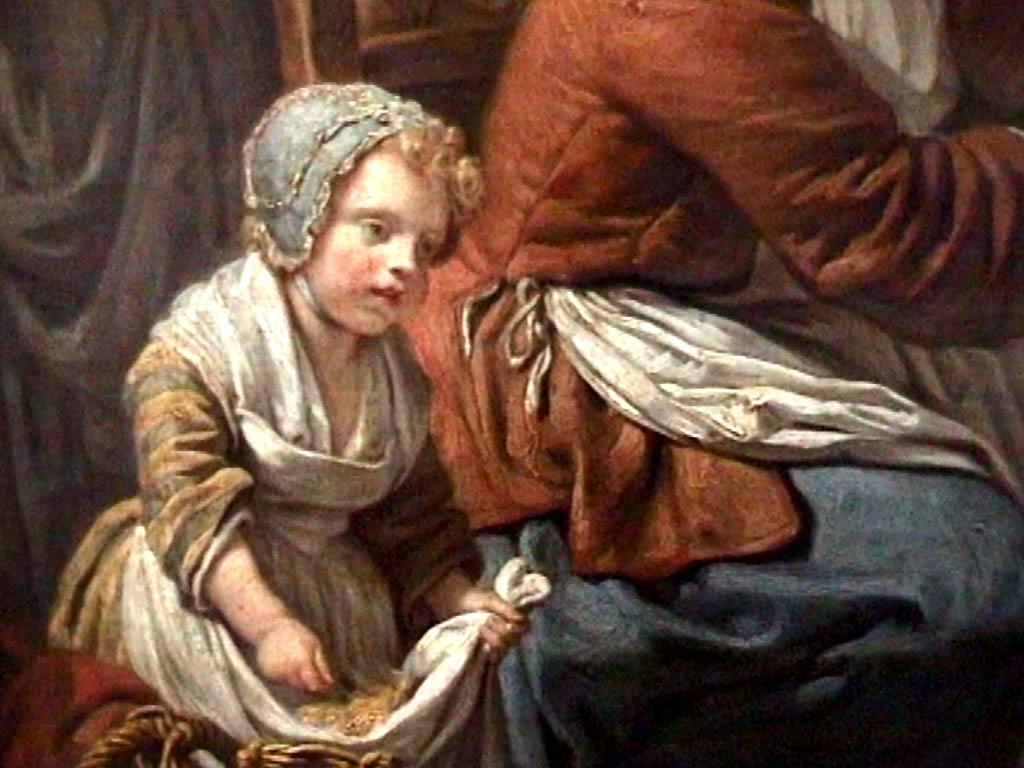
Both mother and child have the pinned-up bib on the top. See more detail of a pinned-up bib below.
Mom has her apron tied, not in back, but on the side. Her right side. That would be easier for a left-handed person, ISTM.
I have also seen period apron strings so long they come clear around the wearer and are tied in front.
The girl holds her apron up, making a pouch, keeping her little bits in it. She takes a handful of fabric. This is going to be just an automatic gesture for anyone who wears aprons.
As long as I got the picture here , look at the caraco on the woman above. I think there's a slit in the side seam to allow access to a pocket beneath.
More on pockets below.
See how the child has her fichu tucked into the top of her apron bib. There must have been an art to tucking the fichu.


The clothes are much too early to be relevant. But see how our gal on the left has her aprong converted fully into a secure pouch for carrying . . . I dunnoh. Maybe the entire Oxford English Dictionary or watermelons.
She's tucked the hem of the apron neatly into her waist at the middle, letting it gape a bit at both sides.
Note also that this is a dark blue apron. I have other examples of dark-coloured aprons in France, at least one of them in period. See the 1794 apron on the tricoteuse further below.


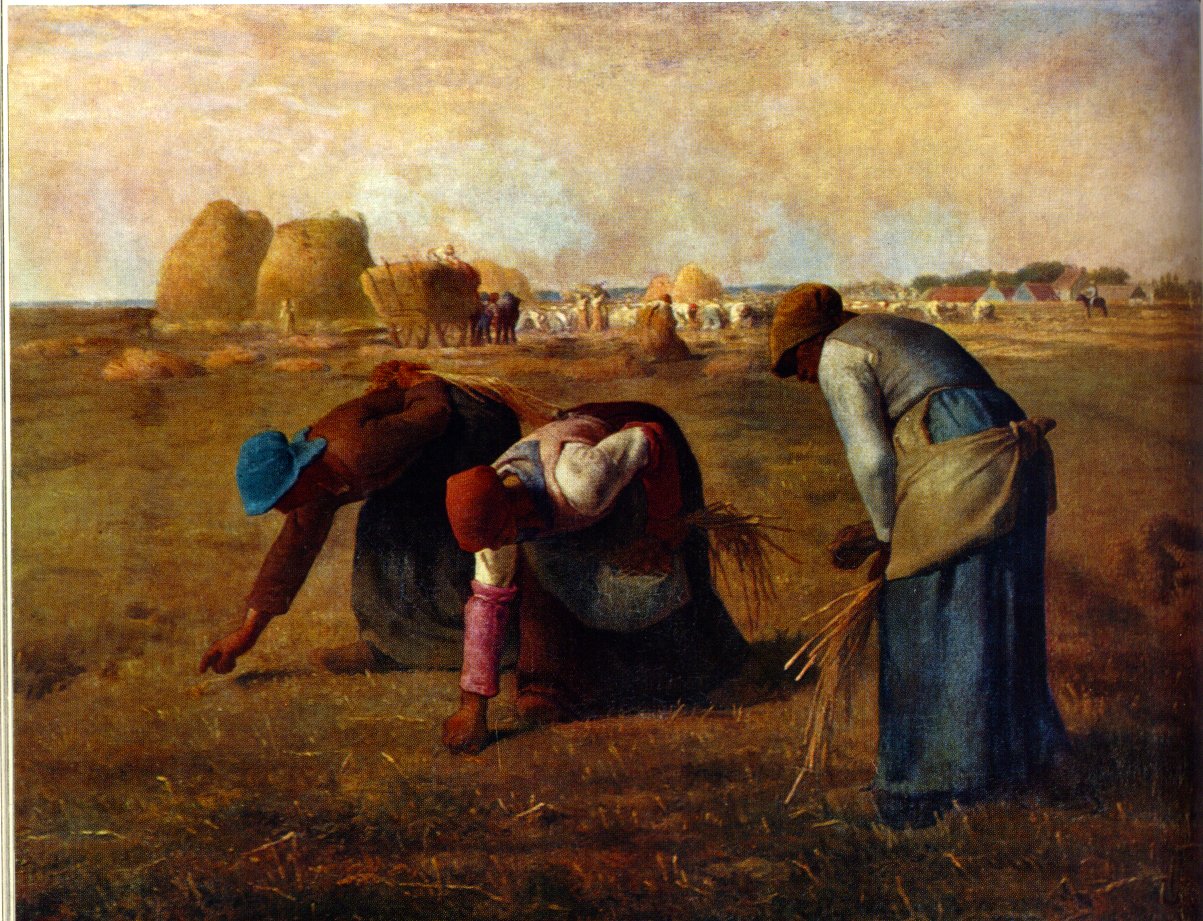
I'm just wandering all over the place, timewise, ain't I?
This Millet is here only for the custom of typing the apron back behind the butt like this and making a big carryall. I'm assuming this was done in my era too.
But since you're tired of me wandering all over French history ... we got some truly period aprons coming up.
Lookit.
The next ones are early 1790s, as are the tricoteuses further on.


In the picture where our sansculotte young lady is carrying a sword, see the way the skirt is drawn up on one side and tucked in. It's on her left side. Right-handed sansculotte?
Visit that bottom print at home here,

In other news, in these three prints, note the mid-length hair, worn undressed and loose under the cap. Note the sabots. Note the striped material of the skirts.
Our lady above, on the upper left has a little basket on her arm and what looks like a bag slung at waist level. I think the basket is to hold yarn. We see the same thing in the Greuze painting below. The little pouch on the side of her seems to be an exterior pocket. I've seen these from time to time.

And here we got Les Tricoteuses Jacobines by LeSueur, which is, of course, smack dab in period.

Our knitters have specialized aprons. Little pockets on the right, (their right,) side of the skirt.
And here is the dark apron I mentioned. So they weren't all white, even among our working class gals.
One way we know they are working class is the length of their skirts. See our gal on the right? Short skirt = laboring class.
Find our tricoteuses here.
Below is a rather interesting take on that 'tricoteuse apron'.


This is the Palai Royale, a noted haunt of prostitutes.
See the madame in the back offering the pretty young knitter to that unpleasant fellow? Her pocket says she's a working girl and gives the impression of an innocence she's about to sell.
Find it here.


Now ... here is Greuze, La Tricoteuse Endormie.
Let us all pause to go aaaaaawwww.
Ahem. Back to business.
This apron shows how the bib attaches. See how one side has come unpinned?
Purely by the by, see those four needles in the knitting? I have tried to knit with four needles. I will blog about that.
And we got that basket the 1794 knitters carry to hold their ball of yarn when they don't have a pocket in their skirt..
Moving on to the fascinating subject of 'pockets'.
'Pockets'
These were not the sewed-in feature we are used to. They were a little bag tied at the waist, under the skirt. Often this was two pockets, tied separately, and worn one on each hip.
This makes comprehensible the nursery rhyme:
Lucy Locket lost her pocket,
Kitty Fisher found it.
Not a penny was there in it,
Only ribbon round it.
which has worried and puzzled generations of readers.


We have some early C18 pockets here, from the V & A.
These are linen, sewn with linen thread, embroidered in coloured silks, with silk ribbon and linen tape
A couple more below.

Find them in detail here.
These are from Meg Andrews, Antique Costume and Textiles. Her site is here. These pockets are white cotton, marcella quilted, joined on a wide 2 inch band. They tie with tapes. There's a different design on the two pockets. Odd, what.


Here's a pair of 1796 pockets -- exactly in era. These are embroidered linen.
They belong to the Met, which welcomes you here.


You're wondering how folks got into their pockets in 1794?
Folks got into the pockets by reaching through slits in the seam of their skirt. The caraco in 1794 wouldn't have been long enough to interfere with access, so they could just go through that skirt.
Lookit here where you see just exactly those slits.
They're doing the other thing they did with these pocket holes, which is they pulled a hank of skirt up through them to shorten the skirt. Fashionable women did this for 'the look'. Working women did it to get the skirts out from underfoot.
Or for the look, I guess. And this print is from Yale. Find it Here


Here you get a look at the slit in the side of the skirt where our young lady could reach in and get to the pockets. See this picture, here. Click at the site for a closer look.
Subscribe to:
Posts (Atom)