I hate it when the characters are supposed to do something particularly clever.
I put it in brackets.
[Adrian and Justine figure this out, being clever]
And then when I come back I sit and look at it and can't come up with anything.
I am not feeling clever at all.
The garbage disposal has stopped working, which may have something to do with a quantity of activated charcoal getting down into its little innards. The light bulb on the microwave has broken. I have never had the lightbulb in a microwave stop working. And the bottled water dispenser beeps at me when the water runs out. So stupid of it.
I know there's no more water. I push the button -- see -- and nothing comes out.
I am disgusted with civilization. I am going to get me nine bean poles and a hive for the honey bee and just not possess anything with electrons running through it except possibly the computer.
Hah!!
I will get next winter's firewood delivered and go stack that and maybe put my spirit on a more even keel.
In other news, I have figured out that I own 80 linear feet of books.
I'm rounding the corner on the last section of the ms. Looks like the Very Rough Draft of JUSTINE is going to fall at 100,000 words. That means I'll be adding much layering and description to the Second Rough Draft.
I go back and forth on liking the plot structure. Right now, I feel ok about it.
I just finished reading Laura Kinsale's Midsummer Moon.
(Pause to say -- Why did they give Kinsale such dreadfully bland and forgettable titles? Why? Why? Why? That one should have been titled 'What the Hedgehog Saw' and then I would remember the title and everyone else would too.)
I will not be able to read Kinsale again till I am at a stopping point in JUSTINE because she is so good she makes me want to cry and just stop writing prose and go be a greeter at Walmart or go back in the Foreign Service and get sent to Afghanistan.
Monday, March 29, 2010


Saturday, March 13, 2010
Yet More Questions
Way down the posting trail . . . going back to January . . . there's a bunch of postings answering questions I got asked here and there.
I didn't finish with them. Here's some more:

So.
You have questions?
12) You had some fresh and unexpected twists -- did these come to you with your first draft or did you work in these twists during your revision process?
I am delighted you think some of this was fresh and exciting.
Let me talk about the blindness plotting because it's fairly typical of how this works.
I still don't know if the book wouldn't be better without it.
So, yes, the action/suspense/spy plot of the story was pretty much in my head when I began writing.
 But then you have the surprises.Annique's special memory was something I came up with the second or third or fifth draft of the story. Originally I had her smuggling around a book with all this information in it. Awkward and unworkable.
So some plot twists were there in the original basket. Some of the plot ideas I started with got tipped out of the basket along the way. And then there's some interesting stuff I picked up as I wandered tra la la down the path and I didn't think of it at all till I was in the middle of writing.
12) Any authors or books you feel you learned from either fiction or non-fiction?
I steal from only the best, so You know how they have these questions on interveiws about what books most influenced you?
I love this, because I pick up stuff everywhere and I just wish I could acknowledge it all.
When I was in grammar school, Fifth Grade maybe, I read Coming of Age in Samoa by Margaret Mead. The book said that the different roles taken by males and females, even the different temperament that is assumed to be proper to each sex, is determined by the society rather than by anything innate.
I never write a female character without asking myself . . . 'this bit that my heroine is doing -- is this something I could see a male doing? Am I assigning this character a 'female' role and making her passive or dependent by doing so? What am I saying about the female spirit when I write this?'
Fiction that influenced me? . . . well, it's all the usual suspects: Bronte, Heyer, Austen, Sayers, Dunnett, Sergeanne Golon and another writing team, the Curtises, R.A. Heinlein, Bujold, Lackey,and Zelazny, (all great S.F. storytellers), Tolkien, (is there anyone who doesn't put Tolkien on these lists?)
Current Romance greats would include -- and Lord, this is not limited to these wonderful writers -- SEP, JAK, NR, Kinsale, Ivory, Chase, Kleypas, Beverley, Gabaldon, Gellis, Quinn, Putney, Balogh.
I've read every word these writers have in print. I keep learning from them.
(ETA. It was pointed out to me that I've used 12 twice. Well, heck.)
14) How do you feel winning the RITA impacted your career if it did?
The conventional wisdom is that winning the RITA has zero effect on sales. Readers have never heard of the award. They don't know what it means. Marketing mavens who will slap on a big cover quote from the 'Yellowknife Morning Chronicle' won't bother to mention the RITA.
But writers know what the RITA means. Writers award the RITA. This is writers honoring other writers. So much an honor. I'm still stunned whenever I see the golden lady sitting on my shelf.
Going back to the practical of whether a RITA win has an effect on sales . . .
There's this -- while readers maybe don't know the RITA, the people who work in agenting, editing, marketing and publishing Romance do. The book buyers for stores know what the award is.
So maybe the RITA will give me just a little blip of recognition with these folks.
It can't hurt, anyway.
I haven't run out of these questions, y'know. I just figure folks are getting bored, along about now.
Not that that makes me turn off the spigot on a posting, generally.
Anyway, I'll be back with the other Q&A
eventually.
I didn't finish with them. Here's some more:

So.
You have questions?
12) You had some fresh and unexpected twists -- did these come to you with your first draft or did you work in these twists during your revision process?
Let me talk about the blindness plotting because it's fairly typical of how this works.
Annique's blindness was part of the original planning of the story. This was also the plot idea I had the most doubts about. I liked writing it, but I didn't think it would sell. Even in the final manuscript I was wondering if I shouldn't rewrite and pull it out.
I still don't know if the book wouldn't be better without it.
The blood relationship between Annique and Galba was also part of the original plotting. I needed this to make Annique's final welcome into the British fold plausible.
So, yes, the action/suspense/spy plot of the story was pretty much in my head when I began writing.

So some plot twists were there in the original basket. Some of the plot ideas I started with got tipped out of the basket along the way. And then there's some interesting stuff I picked up as I wandered tra la la down the path and I didn't think of it at all till I was in the middle of writing.
12) Any authors or books you feel you learned from either fiction or non-fiction?
I love this, because I pick up stuff everywhere and I just wish I could acknowledge it all.
When I was in grammar school, Fifth Grade maybe, I read Coming of Age in Samoa by Margaret Mead. The book said that the different roles taken by males and females, even the different temperament that is assumed to be proper to each sex, is determined by the society rather than by anything innate.
I never write a female character without asking myself . . . 'this bit that my heroine is doing -- is this something I could see a male doing? Am I assigning this character a 'female' role and making her passive or dependent by doing so? What am I saying about the female spirit when I write this?'
Fiction that influenced me? . . . well, it's all the usual suspects: Bronte, Heyer, Austen, Sayers, Dunnett, Sergeanne Golon and another writing team, the Curtises, R.A. Heinlein, Bujold, Lackey,and Zelazny, (all great S.F. storytellers), Tolkien, (is there anyone who doesn't put Tolkien on these lists?)
Current Romance greats would include -- and Lord, this is not limited to these wonderful writers -- SEP, JAK, NR, Kinsale, Ivory, Chase, Kleypas, Beverley, Gabaldon, Gellis, Quinn, Putney, Balogh.
I've read every word these writers have in print. I keep learning from them.
(ETA. It was pointed out to me that I've used 12 twice. Well, heck.)
14) How do you feel winning the RITA impacted your career if it did?
The conventional wisdom is that winning the RITA has zero effect on sales. Readers have never heard of the award. They don't know what it means. Marketing mavens who will slap on a big cover quote from the 'Yellowknife Morning Chronicle' won't bother to mention the RITA.
But writers know what the RITA means. Writers award the RITA. This is writers honoring other writers. So much an honor. I'm still stunned whenever I see the golden lady sitting on my shelf.
Going back to the practical of whether a RITA win has an effect on sales . . .
There's this -- while readers maybe don't know the RITA, the people who work in agenting, editing, marketing and publishing Romance do. The book buyers for stores know what the award is.
So maybe the RITA will give me just a little blip of recognition with these folks.
It can't hurt, anyway.
I haven't run out of these questions, y'know. I just figure folks are getting bored, along about now.
Not that that makes me turn off the spigot on a posting, generally.
Anyway, I'll be back with the other Q&A
eventually.
Wednesday, March 10, 2010
Dreaming . . . Dreams, dreams, dreams . . .
Thinking about using dreams in a story.
First off -- if anybody wants to write dreams, they should go for it. There's the vast panoply of Western literature to back you up. It's full of dream sequences.

-- With a dream sequence, the reader 'sees' the technique. She gets a glimpse of the stagehands moving the props around, as it were. It's an inherently intrusive technique -- like chaptering. But, unlike chaptering, it's unusual enough that the reader notices. It's heavy handed. Or heavy footed. Or something.
First off -- if anybody wants to write dreams, they should go for it. There's the vast panoply of Western literature to back you up. It's full of dream sequences.
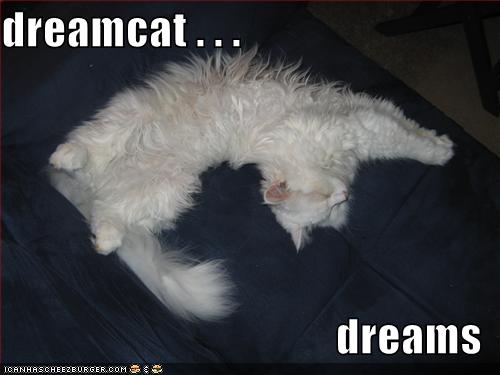
The downside of using a dream sequence is . . .
Sunday, March 07, 2010
Injecting Present Tense
I was pondering verb tenses the other day. Thinking about the tenses we employ when we write in Past Tense, as we generally do.
'Past Tense' should really be called 'past tenses' because you got yer
Simple Past Tense, [Myrtle hunted,]
and yer Past Progressive, [Myrtle was hunting,]
and yer Past Perfect, [Myrtle had hunted,]
and yer Past Progressive, (or Past Perfect Continuous,) [Myrtle had been hunting.]
And there may be some others, for all I know. All these verb tenses carefully define relationships between the particular bits of the past when stuff is happening. They are the 'home tense'.
'Past Tense' should really be called 'past tenses' because you got yer
Simple Past Tense, [Myrtle hunted,]
and yer Past Progressive, [Myrtle was hunting,]
and yer Past Perfect, [Myrtle had hunted,]
and yer Past Progressive, (or Past Perfect Continuous,) [Myrtle had been hunting.]
And there may be some others, for all I know. All these verb tenses carefully define relationships between the particular bits of the past when stuff is happening. They are the 'home tense'.
Friday, March 05, 2010
The JUSTINE Manuscript

Slowly . . . slowly . . . slowly.
I've finished up a big section and I'm moving on to new territory.
Trying to limit the number of characters in the manuscript.
Trying to simplify this maze of a plot.
I'm about 50K words into the Very Rough Draft.
Subscribe to:
Posts (Atom)