Saturday, December 24, 2011

Technical Topics -- Advice on POV, the Collected Set

In the Comment Trail, Catherine says,

"Now, do you have a post on Point of View? That is something that really, really confuses me.

Obviously I'm okay writing in first person cos there is only one POV, but when I get to third person I get very confused about whose POV I'm looking from.

Can you help, dear Joanna?"


I have written a fair amount about POV.   What I'll do is give you lotsa links to where I'm nattering on about it.
But I'll do it in random order.  And probably repeat myself.
Just to make it challenging.

I hope this is of some use to you.


Here is me talking about POV and language.  This is An Overview on Building POV 

Then there are the exercises.  I did an exercise on POV in the Books and Writers Forum in June 07.   This, Here, is the description of the exercise.  My writing snippet that I contribute to the exercise for discussion is here.  Other folks contributed their writing to the exercise herehereherehere,   herehereherehereherehereherehere, and  here.  We all talked back and forth about POV.

We did couple similar POV exercises that year.  See here for links to all four of them. The message tells you how to track down the discussion and writing of those exercises.   

Here's me talking about how we use character names when we're in various folk's POVs.   I make a couple other comments in that thread.  Then there's more randomness  Here, herehere, and here where I'm looking at a particular bit of someone else's writing and giving advice, trying to bring the snippet deeper into POV.

Leesee . . . more delights lie ahead.

Here's me analyzing a scene, which is not so much about POV.  Here I talk about POV and pacing.  Here is some of me talking about visualizing story from a POV starting point.  Here's more on character development, which is, again, not so much on POV.  Here  Omniscient POV.  Here  defining how POV works.  And here's some thoughts on the use of 'I' in 1st person POV.

Going over to Absolute Write . . .  This is a set of random posts where I touch upon POV in some way.  If you want to see the the other messages in the thread so you can figure out what is going on -- and, who knows, you might want to  --  click on the upper right hand corner where it says, 'thread'.  That will give you the entire thread where you can even read what other folks have to say.
multiple POVs

Ready?  Steady.  Go!

Here, herehere, here, herehere, here, here, here, here, here, here, here, here, here, here, herehere, herehere, here, here, here, here, here, herehere, here, here, here, here, here, here, here, and finally at long last here.

I get to contradict myself, by the way.  I get to talk nonsense.  I get to be just plain wrong, okay?

Oh.  And  Here's Doris Egan on POV which will doubtless be useful .  And more from her, here.

Thursday, December 22, 2011

Authorial Intent and Reviews.

Jennie, at Dear Author writes:
 ***

"When I address authorial intent in reviews, it’s generally because I’m confused or bothered by something in a book. I don’t ever pretend to *know* an author’s intent, but sometimes I have ideas about what I *think* the author was going for. For instance, in the latest Joanna Bourne, I felt like the author made choices that deliberately made the heroine weaker than the hero (though no one seems to agree with me on that, which is fine). As is often the case, I chalked it up to romance genres conventions – the hero is favored a bit (by the author and presumably the reader) over the heroine, and the hero is expected to assert some mastery over the heroine. So I am assuming that the story is written a certain way to please the average reader.

"Is it wrong for me to assume I know the author’s intent? I don’t know, but I do know that I’m not just doing it to be an asshole – I’m addressing something that bothers me, and furthermore why it bothers me (my belief that romance still tends to be rather conventionally sexist in a lot of ways). I think I need to acknowledge my assumptions about the author’s intent to give context to why I feel what I feel."

***

I just about entirely don't respond to reviews or speak in the comment trail of discussions about my own books.  It's not that I'm not grateful for the interest.  But,

-- I don't want readers to think I'm looking over their shoulder when they discuss the books.  That has to be quelling.

-- I think books have to stand up for themselves, without explanation or defense.  

-- There's not much to say if somebody doesn't like the work.  It's like lichee nuts.  Lots of wonderful, intelligent, interesting folks are going to not like my books or lichee nuts and no amount of discussion is going to change this.

-- The most important reason I don't respond to comment or criticism is that I don't want to make a fool of myself, which is what folks mostly do when they try to defend something they've written.

But, breaking a long habit of keeping my mouth closed, I'm going to go ahead and respond here.

 ***

Dear Jennie,

I don't deliberately make the female protagonist of my stories less strong, competent or active than the male protagonist.  If I felt the Historical Romance genre demanded that the heroine be weaker than the hero, I wouldn't write Historical Romance.

It's true my heroes tend to be more skilled in killing than my heroines.  If there were only one sort of strength -- killing people -- then I'd have no argument.  But I'm trying to write stories about the decisions characters make, rather than stories that are primarily about killing people.   I'm writing about the strength that's shown by decision-making.     

At the end of Black Hawk, Adrian has grown to be the kind of man who refrains from killing his enemy until he has solid, incontrovertible proof of guilt.  Adrian's story, through several books, has been about acquiring ethics and self-control, not about learning to kill more skillfully.

And Justine's strength?  In Black Hawk I use Justine's willingness to give up her sister, her decision to risk her life to rescue the Caches, and her determination to overcome degradation and rape to show her strength.  She has spy skills -- they're probably better demonstrated in Forbidden Rose than in Black Hawk -- but I'm mainly interested in the hard choices she makes.

Is Adrian the 'better spy'?  He brings formidable spy skills to the table.  Consider his lockpicking.  He stands behind Justine and mentally complains about how slow she is getting through a door.  

But lookit at what's really happening in that scene.  Justine enticed him to that door, (which is why he's snarking at her.)  She holds all the knowledge in this situation.  In a few minutes she's going to make him do exactly what she wants.

Who's the master spy?  The boy who can pick locks?  Or that clever, clever girl with her knowledge and determination and her sure understanding of what makes him tick? 

I can't argue that you somehow should feel the balance of power and strength between hero and heroine is equal. Everybody who reads the book is going to have a different emotional response to what I consciously or unconsciously put in the story.  I can only say it is not my intention to show the heroine as weaker than the hero.

Jo

Wednesday, December 21, 2011

Technical Topics -- Character Development Scenes

Somebody says -- "I have a couple of scenes that are basically only used for character development, and I'm having a hard time writing them . . .  I feel a little strange about writing it because hardly anything noteworthy actually happens."

That's the sort of scene you cough a little and say -- "That's a character development scene," when somebody asks why it's in the manuscript.  It's the sort of scene that showcases and explains the character --  well, lots of scenes do that --  but when you think about it, nothing important to the plot took place.  There's no necessary decision, no character change, no story action. The scene could be removed without affecting what happens later.

The problem with character development scenes (and flashback scenes, talking head scenes, and prologues of this type,) is that they're written to convey information, rather than getting on with telling the story.

Now, IMO, there's nothing inherently wrong with having a few no-progress scenes in the manuscript. We have all this cool information lying around, after all, so why not pass it along to the reader?

But if the writer's going to drop the reader into a static, informational scene, the writer has to know he's stopped telling the real story. When he's done with his flashback or his character development scene, he's going to pick up the plot again in the same place as before. No forward movement. The writer had better want to slack off on the pacing, because that's what he's just done.

Readers don't so much want the story to stop dead in the water, so the writer had better make this digression interesting.

Some writers always start out with a couple just informational scenes as warm-up writing. It's an exercise that helps them organize their thoughts. It's part of their process. They pull the scenes out later and expect to.
No harm, no foul

But I think sometimes no-progress scenes arise from a misunderstanding of the old saw, Show Don't Tell. Folks feel they have to lengthily 'act out' specific information instead of just having somebody remark -- 'George has always been shy as a wild rabbit,' or 'It's been ten years, and Elinor has never admitted her passion for canasta,' -- while getting on with more important business like sawing up their latest victim or rearranging the political face of Europe.

Sunday, December 18, 2011

An Ode to Coffee Shops

I do a lot of my writing in coffee shops.
And in libraries.

So I wanted to say, thank you,
to these various places.

And to coffee in general.


This here to the right is not my coffee shop.  This is Les Deux Magots which is in Paris, and where Simone de Beauvoir, Jean-Paul Sartre, Ernest Hemingway, Albert Camus and Pablo Picasso hung out.

They probably drank coffee there.  Though I may be fooling myself and they may have just drunk absinthe and brandy and got plastered.


My own coffee shop is in Virginia, but the principle is the same.  Except for the possibility of getting plastered with attentive waiters and croissants and the literati of Paris as company.


Here's my coffee shop menu of coffees.  You can see we are all extensive and international and sophisticated.

It's pretty good coffee though.

And the baristas have piercings, which makes it authentic.

This is the sofa where I hang out . . . see my computer, hanging out, and that there on the floor is the bag I carry the computer around in.


This is my coffee shop coffee, which I drink in the morning.  It smiles at me.
My coffee likes me.


I need coffee,
btw.
Really.


But I also like tea.

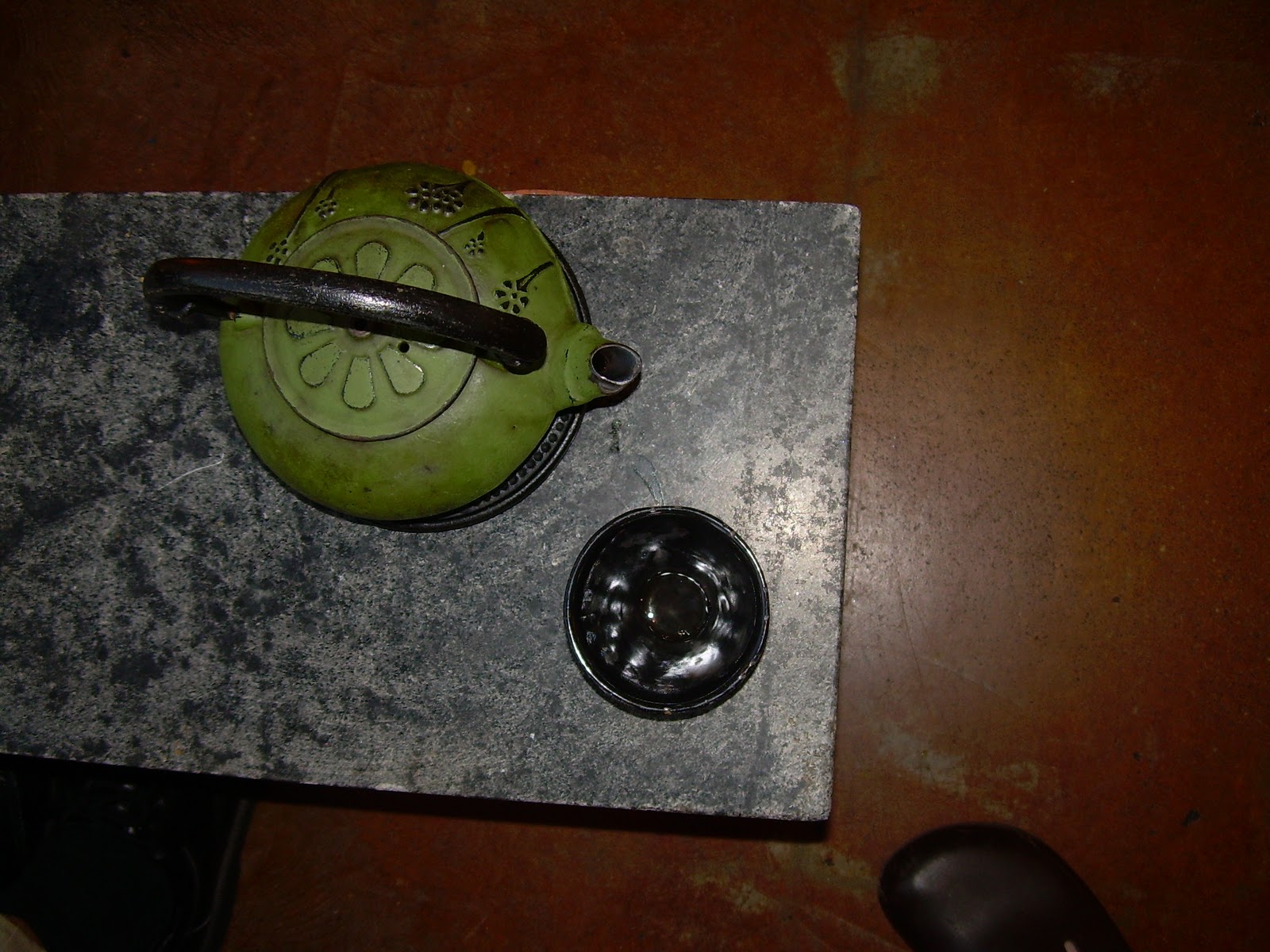
Here is my coffee shop tea, which is what I get in the afternoon, so I will be able to sleep at night.

I will not say my conscience is entirely clear, but mostly it is having too much caffeine that keeps me up at night, rather than regrets for a misspent youth in the tenor of, 'and yet I could accuse me of such things,' though there is some of that too.


My tea comes in a very heavy iron pot with a very heavy iron cup.  I think they are enameled and this is authentic Chinese tea drinking in which I indulge.

The electronics that surround me are much smarter than I am.  Sometimes my food and drink is smarter as well.


This is the other place I write.  The library.
I don't know why I go there to write since they don't buy my books.

I do not drink coffee, tea, strong liquor, or indeed anything at all at the library. 
They do not allow WATER in the library.  Maybe they think we will get into food fights or something.
The parking lot of the library is particularly lovely.


The interior of the library, however,  is like every other library nowadays.

Why do all libraries look alike?


For instance.  Here is a picture of the Bullock Fire Department in Bullock, North Carolina.

What we have here is some individuality.


If libraries would serve coffee, we would all be better off.

Tuesday, December 13, 2011

Putting Your Fiction Online

Someone asked, more or less,

"I'm an unpublished writer -- should I post chapters of my Work in Progress on my website?"


To which I reply:

There is a definite downside to this.  When you post a significant portion of  a work of fiction online, you may imperil your First Publication Rights.  (That's what you're generally selling when you sign a contract -- those First Publication Rights.) Putting your fiction online may also make your work less salable.  Publishers may be reluctant to buy a novel that's available free on the net.


Why would you want to DO this?
Why would someone want to post fiction online, on his website?
Seems to me there are a couple three possible reasons: 

-- Because he wants to fill up his blog with cool content, but doesn't want to write stuff specifically targeted to the blog and he has this piece of fiction handy.

Advice: If you want to keep a blog, write stuff intended for your blog. Don't be lazy.
Cool story example


-- Because he believes his fiction will draw traffic to his blog. He wants to build a following.

Advice: Do you read one chapter of a good book and then return it to the library?
Not so much.
Why would the readers of your blog feel good when you cut off your ongoing story, having just interested them?

Not the way to bring folks back to your blog.

'Teaser excerpts' of your cool story work when they point the reader to a buy button. If you can't include a link to the whole work, you've annoyed the folks you want to attract.


-- Because he wants praise/advice/discussion/feedback on his writing.

Typical Writer's Group
Advice: Join a writer's group.  Join or form a critique circle.  Print up copies for your friends.
 

Try Absolute Write.  
Try Compuserve Books and Writers Forum.


-- Because an agent or editor might drop by and see the work and be bowled over by it and get in touch with him about publishing it.  He heard this happened to somebody.

Advice: This is not so likely. 

Consider the slushpile an agent or editor has in her office: Here, Here. Here. Here.

With this kind of mail arriving every day, do you think agents and publishers go out trolling the web for more submissions? The odds of finding an agent or editor are astronomically better if you finish the work, send out queries, and submit the manuscript.


-- Because he does not have a completed manuscript and he wants someone to appreciate his writing right NOW.

Advice: I understand this.  Writing is a lonely business.  We don't get much feedback when we're working.
But . . .  posting a rough, flawed, unedited draft of your work is not respectful to the readers of your blog. If you intend to build a blog following, treat these people as you will someday treat your readers. Give them your best work.


-- Because he doesn't think the story will ever be published. He sees this as his only chance to share with a larger audience.

Advice: This is why folks post on fanfic sites -- this desire to share their work.
It's a generous impulse I hate to quell.

But do you intend to be a professional writer and get paid for it? 
Then trust yourself. Trust your work.


Later on, when you're published, you may regret that some of your apprentice work is out there online, haunting you, with all the newby mistakes that you can never, now, correct.

Thursday, December 08, 2011

Technical Topic -- Historical Romance versus Historical Fiction

Someone asked elsewhere, "I write historical fiction. But I love a good love story. And so I set out to write a story where the love story played a prominent role  . . .  I've read about a "formula" that most romances adhere to; I know that I haven't stuck to it."
Is this book a Historical Romance?

Well . . . it might be.  Then again, it might not.  A 'love story' isn't enough to put you on the Romance shelves.

What it is --
There are many more titles on the shelf that call themselves 'Historical Romance' than there are titles in the 'Historical Fiction' section. Maybe it looks like it would be easier to go the Romance genre route.

But, not so much.  The many Romances are not really germane to a book stuck in the no-man's land between Historical Fiction and Historical Romance.  They're lighter reads.  History is a backdrop in these books, not a main player. Getting a dense and accurate Historical Romance published is probably about as difficult as getting published in Historical Fiction.

What you cannot do is get a book published as Historical Romance if that is not what the book actually is. The agents and editors are really canny about this. They know.

To qualify as Romance -- (I'm talking via my direct link to Infallible Knowledge here) --

(a) At least half the manuscript should be the male and female protagonists in the same scene, face to face.

(b) Another quarter or so, if you can't put the two protagonists face to face, should be scenes directly related to the MMC (Male Main Character) or FMC (Female Main Character.)

(c) The POV should be either MMC or FMC, (unless it's Omniscient Narrator,) for more than 90% of the writing.  You will see that this means almost every scene has one of the two protagonists in it.

(d) Here we come to the big one:

The central problem of the story -- the stuff that sends everybody into action -- is solved when the MMC and FMC finally get together at the end.

That is -- the central problem is not the Queen's Pearl being misplaced or Princess Elizabeth dodging the ax long enough to inherit. The central problem is that Thomas and Anne can't get married because their grandparents are feuding.
You know what problem is central to the story because most important actions the MMC and FMC undertake are motivated by that. We see them act in ways that will get them married rather than merely recover the Missing Pearls.

(e) In a Historical Romance, the FMC should have considerable 'agency'. She does stuff, and important later events happen in response to her action.

(f) The ending should be upbeat. There is a plausible HEA for the MMC and FMC. Everybody walks away smiling, except the villain.

(g) Nobody kills a puppy. This means the MMC's friend does not die lengthily on stage. Nobody the reader cares about dies.

(h) As a minor note, the word count is going to be under 120K.  Better and more salable if it's under 100K.

(i) Roberta Gellis did this.  Georgette Heyer got away with this once or twice.  But a brand new Historical Romance author probably can't.

Do not write about history.

By this I mean, be as accurate as you want, but do not have the narrator or any character tell us 'Why Henry VIII had money in the treasury when he inherited' or 'Why the 1814 Battle of Paris was a good deal more important that the Battle of Waterloo'. No consecutive 300 words should convey historical information.

If the readers of dense, accurate, well-researched Historical Romances want to read Historical Fiction, they know the way to those shelves. When they pick up your Historical Romance they do not want to read Historical Fiction.

Sunday, December 04, 2011

Technical Topic -- Just a minithought on Show and Tell

Mostly, I hate to use the terms 'show' and 'tell' because I find them confusing.

I'd rather talk about basically the same concepts by calling them 'Here&Now' and 'Being Elsewhere'.

When the POV character is immersed in the sensory components of the scene or is involved in on-going action or is speaking dialog that deals with what's right there underfoot in the scene -- that's being in the Here&Now.

When the POV character is talking or thinking about stuff that's not going on at the moment in front of him, he's gone Elsewhere.  The character does this when he's adding backstory or infodumping or describing what happened last week or to his cousin who lives in Altoona or thinking about what he might do in the future and stufflikethatthere.

John picks up the toast and bites into it, tasting jelly
-- Here-and-Now
John burns his mouth on the hot coffee -- H&N
John remembers his mother made good coffee -- Elsewhere
John hits Maurice over the head with a hammer -- H&N
John sees Maurice fall down dead -- H&N
Three hours later John describes the murder to Mary -- E
John thinks about the morality of murder while driving home -- E
John is afraid he's going to get arrested and hides under the sink -- H&N
John buys bleach to clean up the murder scene - H&N
John and Thomas plan to bury the body --E
John and Thomas bury the body -- H&N 


In general, I try to stay in the Here and Now of the scene, because that's where the story is happening.

It's all very Zen, y'know.  If I stay with the POV character and he's immersed in what's going on around him, the reader gets to move through the scene and watch it unroll, event by event.  Everything is solid, sensory, relevant to this fictive instant, logically successive in time, each emotion related to the next action, showing motivation that forms minute by minute.  The reader is caught in a stream of events that pulls him along.

Whenever I take the reader Elsewhere, I relegate the experiences to second hand.  I pull the reader out onto the bank to show him birches and willowtrees.  They may be interesting, but they are static.  He's plucked out of the story.  No longer dragged along by it.

Somewhat, this is the difference between information and story action.
I get all philosophical here and ask myself about the nature of fiction.
The fictive experience does not lie in the knowledge of events.  It's being part of the events.

That said --  there is a place for just plain laying down information.  You have to do it.
But don't mistake conveying information with putting the character inside the ongoing story, which is your main objective.